
Table of Contents
-
Overview
-
What’s New in GPT-5.2
-
Focus on Long-Context Reasoning
-
Productivity Gains for Businesses
-
Enterprise Strategy Behind GPT-5.2
-
Final Thoughts
-
FAQs
Overview
OpenAI has officially released GPT-5.2, its most advanced artificial intelligence model so far. The new model represents a major step forward in performance, reliability, and real-world task execution, especially for professional and enterprise use cases. The launch comes at a time when competition in the AI industry is heating up, with companies racing to dominate business workflows.
GPT-5.2 builds on the foundations laid earlier by GPT-5 and GPT-5.1, but with noticeable improvements across reasoning, coding, tool usage, image understanding, and long-context processing.
What’s New in GPT-5.2
According to analysts and early testers, GPT-5.2 shows stronger consistency in multi-step problem solving. Unlike earlier models that sometimes struggled with long or complex tasks, the new version handles planning, iteration, and structured outputs more reliably.
This makes GPT-5.2 better suited for professional environments where accuracy, repeatability, and logic matter more than quick one-off answers.
Key improvement areas include:
Reasoning across complex tasks
Improved coding accuracy and debugging
Better use of tools and structured data
Stronger image and document understanding
More stable outputs in long conversations
Focus on Long-Context Reasoning
One of the biggest upgrades in GPT-5.2 is its ability to handle very long contexts without losing coherence. The model can now process extremely large documents while maintaining accuracy throughout.
This opens up enterprise-level use cases such as:
Legal contract review
Compliance and legal discovery
Academic and market research synthesis
Technical documentation
Multi-file software development projects
Independent evaluations suggest GPT-5.2 maintains accuracy across tens of thousands of tokens, significantly reducing context drift and hallucination issues that affected earlier generations.
Productivity Gains for Businesses
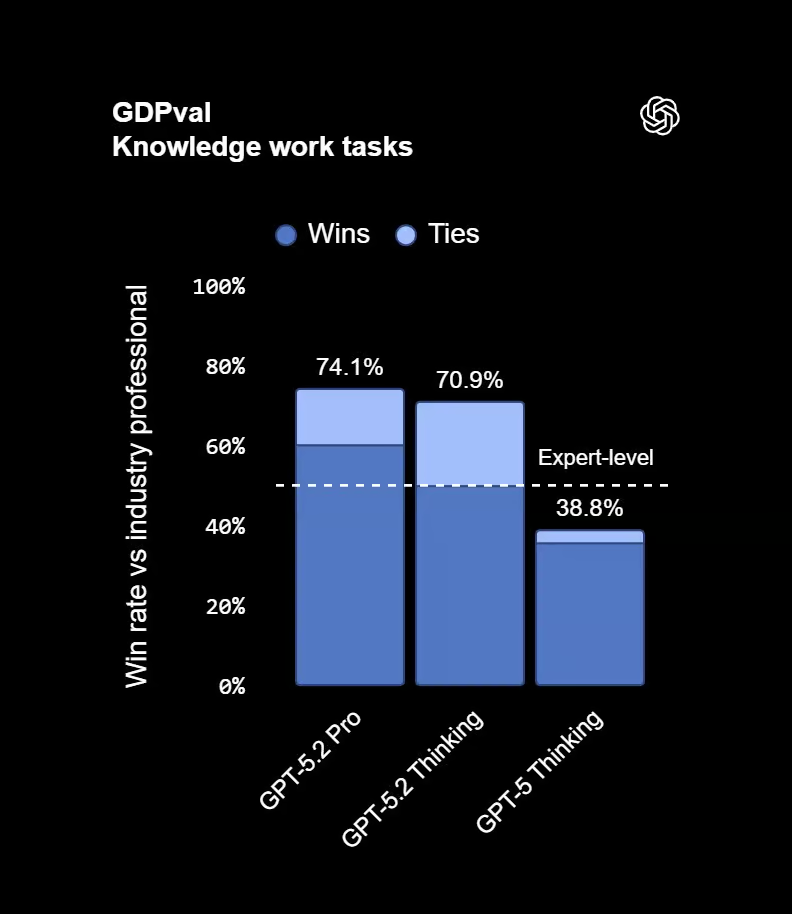
OpenAI is clearly positioning GPT-5.2 as a productivity engine for enterprises. The model performs better in tasks like spreadsheet analysis, financial modeling, report writing, and presentation creation.
Enterprise testers have reported:
Faster task completion
Improved calculation accuracy
Cleaner summaries and structured reports
Fewer logical errors in data-driven workflows
Compared to GPT-5.1, GPT-5.2 shows noticeable gains in decision-support scenarios where precision and consistency are critical.
Enterprise Strategy Behind GPT-5.2
The release of GPT-5.2 reflects OpenAI’s broader strategy to move beyond consumer AI tools and embed large language models deeper into enterprise systems. With features tailored for long documents, structured outputs, and professional reliability, GPT-5.2 is designed to compete directly with enterprise AI solutions from Google, Microsoft, Anthropic, and others.
OpenAI has openly highlighted the update as a major step toward making AI a dependable co-worker rather than just a conversational assistant.
Final Thoughts
GPT-5.2 is not just a routine upgrade. It signals OpenAI’s clear intent to dominate the enterprise AI market by offering models that can handle complex, long-running, and mission critical tasks. As businesses increasingly adopt AI for daily operations, models like GPT-5.2 may redefine how professionals work with data, documents, and decision making systems.
FAQs
1. What is GPT-5.2?
GPT-5.2 is OpenAI’s latest large language model, focused on enterprise-level performance, long-context reasoning, and productivity tasks.
2. How is GPT-5.2 different from GPT-5.1?
GPT-5.2 offers better reasoning, improved long-document handling, fewer errors, and stronger performance in professional workflows.
3. Who is GPT-5.2 designed for?
It is primarily aimed at businesses, developers, legal teams, researchers, and enterprises that need reliable AI for complex tasks.
4. Does GPT-5.2 reduce hallucinations?
Yes, independent tests show improved accuracy retention and reduced context drift compared to earlier models.
5. Is GPT-5.2 part of OpenAI’s enterprise strategy?
Yes, the model clearly reflects OpenAI’s push to embed AI deeper into enterprise and professional environments.